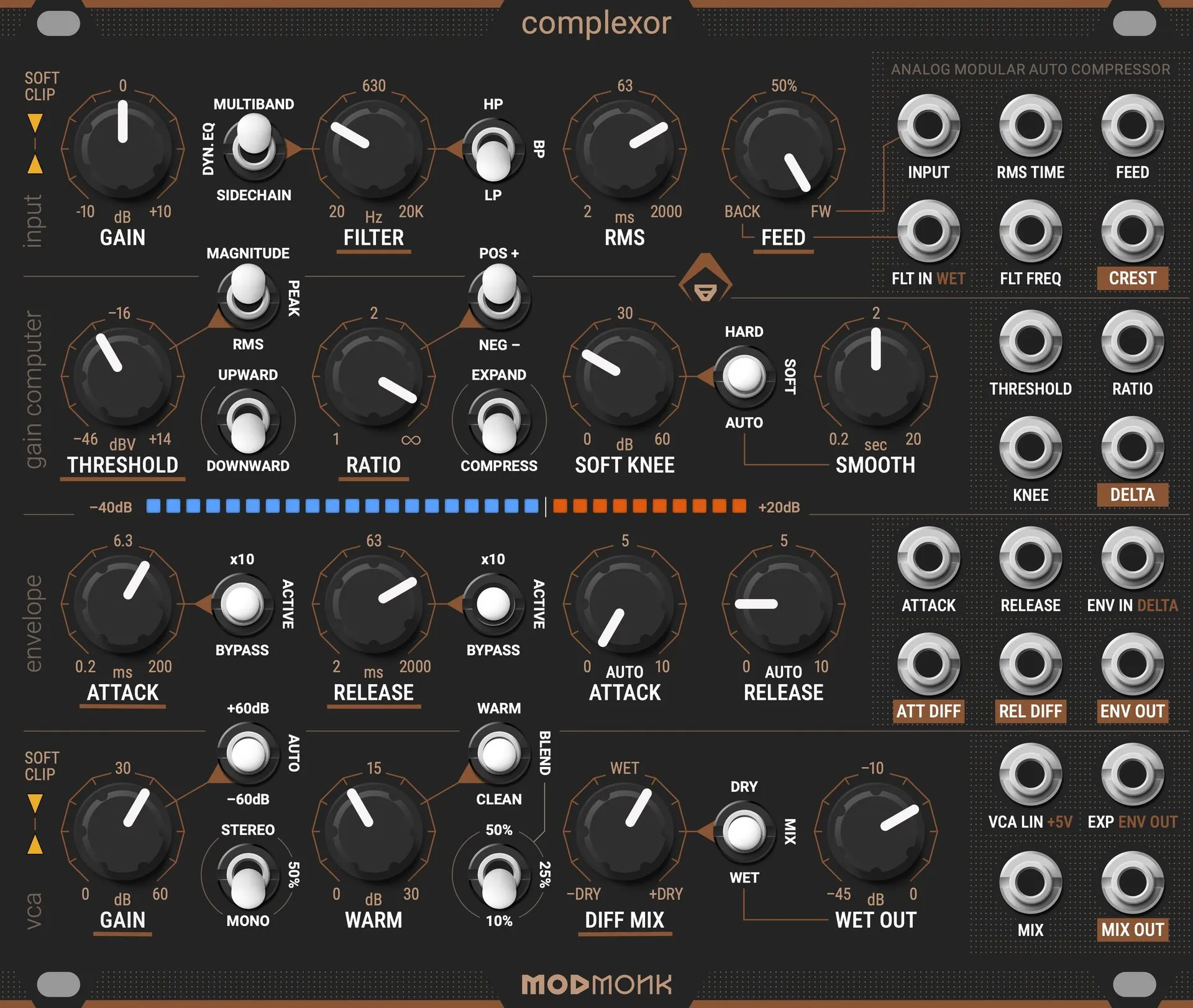
Analogue Modular Auto Compressor
Developed by ModMonk, this Analogue Modular Auto Up/Down Compressor, Limiter, Expander, Saturator, Gate, Filter, Dynamic EQ, Waveshaper and Dual-band processor is a high-performance Eurorack module that integrates established principles of adaptive dynamic range control with an extensive feature set. Its compact design emphasizes clarity and ergonomics, making it well suited for professional audio engineers, producers, and musicians who require refined dynamic range manipulation in a modular environment. The comprehensive and innovative feature set, combined with low-noise analogue circuitry, allows this module to compete with advanced digital dynamics engines, making it a distinguished analogue audio processing solution.
A high-fidelity, original analogue compression architecture developed in accordance with industry best practices and established academic research, this module does not merely recreate or emulate existing designs. Instead, it can match the behaviour of a wide range of hardware and digital compressors - offering cleaner performance and more flexibility than typical analogue units and freedom from aliasing artifacts inherent to digital nonlinear audio processing.
It can deliver anything from ghostly mix glue like a whispering vactrol at 3AM to an unholy storm of voltage-warped chaos that could send even the boldest techno druids fleeing their modular altars. Push it past reason, and your once-pristine signal mutates into a shrieking procession of flaming banjos clocked at 1/128th note, modulating a swarm of feral VCAs riding slewed raptors through a scorched envelope tail. It’s not just compression anymore: it’s sacred distortion, summoned with knobs and switches, baptized in headroom, purged through the noise floor, cleansed at unity gain and sanctified in a feedback loop. Enlightenment awaits: Just 1 V/O a day keeps the devil away!
Dynamics Engine
Beyond Conventional Downward Compression
Unlike standard compressors restricted to downward compression, complexor supports upward compression, downward compression, upward expansion, and downward expansion too. These modes can be combined with adjustable compressor topologies (external sidechain, feedforward or feedback), multiple filter modes (traditional sidechain filtering, dynamic EQ or Multiband modes), 3 different pre-threshold level detection modes (Magnitude, Peak or RMS), automatic gain compensation, positive and negative ratios, and soft, auto-soft, or hard knee settings, stereo linking, saturation, unity gain matched 4 quadrant parallel compression, soft clipping, patch programmability and voltage control on almost all parameters. The result is a significantly broader array of dynamic shaping possibilities, surpassing the capabilities of traditional dynamics processors.
Program-Dependent Dynamics
The module employs automatic, program-dependent compression, dynamically adjusting attack and release times based on the input signal’s crest factor. By continually adapting to both transient and sustained components, it mitigates distortion and pumping artifacts commonly associated with fixed time constants. This adaptive approach allows a range of effects from natural and transparent dynamic control to new sound exploration. The more transient the input signal is, and the higher the Auto Release and Auto Attack amounts are set, the faster the envelopes get. A 10x time switch for the Attack and Release parameters allows for a wider range of control and doubles as a compensation method for the auto fast feature.
Auto Knee
Engaging the automatic knee function repurposes the Manual Soft Knee control into an adjustable Auto Soft Knee parameter. As the average gain reduction increases, the effective knee broadens. A dedicated potentiometer allows for fine-tuning the smoothing interval of the auto soft knee response over a range from 0.2s to 20s, providing nuanced control over transient handling and colouration.
Auto Gain Compensation
When the VCA’s Gain control is set to Auto Gain Compensation mode, the module maintains the waveform’s peak amplitude at 10 V peak-to-peak (±5V, +14dBV), as threshold and ratio parameters are adjusted. This helps maintain consistent signal intensity during dynamic manipulation without requiring excessive manual output compensation to match the perceived loudness between dry and wet signals. Auto-gain compensation is independent from the envelope. Auto compensation is only enabled for Dynamics Engine settings where it makes sense: it is switched off for negative ratios, except when in upward expansion mode. In other words, if the signal’s magnitude is predictable, it is compensated. A manual ±60dB offset adjustment option is also provided, to be able to fine-tune the VCA gain’s offset in a wide range. An extra +20dB and +40dB linear (distortion-free) opamp gain switch is also provided to help the VCA with clean gain compensation or to drive the output soft-clipper and saturator further. The soft-clipping circuit is directly connected to the VCA output’s transimpedance amplifier, allowing both the VCA and Opamp to be driven hard, without risking unpleasant hard clipping present in most analogue designs.
Parallel Compression
Provides both inverted and non-inverted dry signal paths to support parallel processing techniques, enabling transparent loudness enhancement, difference monitoring, and phase-inversion effects.
Programmable Filter Function
In Sidechain mode, the filter shapes the detector’s response without affecting the main audio path focusing the level detector’s response.
In Dynamic EQ mode, the filtered signal is routed to the VCA’s “mainchain” / audio path, creating a frequency-selective dynamic processing.
In Multiband mode, the module acts as a single band of a dual-band dynamics processor: the dry signal is replaced by the off-band signal (i.e., the difference between the filtered signal and the input), allowing complementary recombination like in a multiband compressors.
Filter function + Parallel Dynamics
In Sidechain mode, the output mix stage performs a linear crossfade between the dry and wet signals, enabling standard parallel compression. At 50% mix, both signals are attenuated by -6dB, ensuring unity gain (0dB) when summed.
In Dynamic EQ and Multiband modes, the mix changes to a linear summing behaviour. At 50% mix, the dry and wet signals are added without attenuation, producing a gain-compensated result.
In Multiband mode, the dry full-band signal is replaced by the off-band signal - the difference between the filtered band and the input - creating a complementary band split. The mixer then sums the band and off-band signals together. Because these are complementary and filtered using 6dB/oct filters, the recombination remains phase-accurate and maintains unity gain at 50% mix.
Feed Mix
The filter’s input can be blended between the original input signal and the filter input signal. By default, the filter input is internally normalled to the wet output (after gain and attenuation), enabling both feedforward and feedback compression configurations.
The filter input can also be overridden via an external patch cable to allow for external sidechain compression. The Feed mix still allows blending between External sidechain and the original signal.
When operating in Dynamic EQ or Multiband modes, the feed input becomes part of the main audio path, and thus the Feedback setting creates an audio feedback loop that introduces resonance into the filter. This allows for deeper sonic shaping and exploration. The Feed (Mix) CV input can then be used to “ping” the resonant filter - triggering bursts of resonance with gates or envelopes, similar to how traditional resonant filters are excited.
Stereo Link
Two modules can be linked via a single rear patch cable to enable stereo operation. This connection blends the control voltages (CVs) at each compressor’s VCA input.
Stereo linking is achieved through a passive CV mixer connecting each VCA's CV input.
Alternative stereo linking method
An alternative stereo linking method involves patching the opposite channel’s audio signal into the Filter Input, then using the Feed Mix control to blend between internal and external control signals. This allows audio signal based stereo-linking behaviour without the rear cable, and with an external Mid/Side or Sum/Difference matrix, it enables continuously blendable M/S compression.
You can also combine both stereo methods - rear link and filter input crossfeed - for more advanced stereo dynamics and creative control.
VCA CV Attenuation
If no stereo cable is connected at the back of the module, the Stereo switch instead acts as a CV attenuator, effectively reducing compression and expansion depth on that channel by the same ratio.